News Beyond Headlines
News Beyond Headlines
VIKAS SHARMA
JAMMU, AUGUST: Regimes changed, Jammu and Kashmir moved from being a State to a Union Territory, education policies were rewritten and conferences were held on strengthening school education. Yet, decades later, the fundamental concerns confronting thousands of government schools remain strikingly familiar — shortages and uneven availability of teachers, single-teacher schools and gaps in basic infrastructure.
The latest data of the Unified District Information System for Education Plus (UDISE+) placed before the Rajya Sabha recently has once again brought the long-standing challenges of Jammu and Kashmir’s school education system into focus.
According to UDISE+ 2025-26 data, Jammu and Kashmir has 1,544 single-teacher schools across all management categories. At the same time, the number of teachers in position from pre-primary to secondary level stood at 1,56,404 during 2025-26, marginally lower than 1,56,832 in 2024-25 and 1,56,840 in 2023-24.
The figures raise serious questions about teacher deployment and the continued existence of schools where a single teacher is expected to handle multiple classes, subjects, administrative responsibilities and other duties.
Jammu and Kashmir had 24,228 schools in 2025-26, compared with 24,192 in 2024-25 and 24,296 in 2023-24. In government schools, the UDISE+ data showed 18,748 teachers at the primary level, 38,988 at the upper-primary level, 17,578 at the secondary level and 16,255 at the higher-secondary level.
While governments have repeatedly announced reforms, recruitment drives and measures to improve learning outcomes, education experts believe the real challenge is not merely the total number of teachers but their equitable deployment and availability at the school level.
School education experts said the presence of more than 1,500 single-teacher schools should not be viewed merely as a statistical figure.
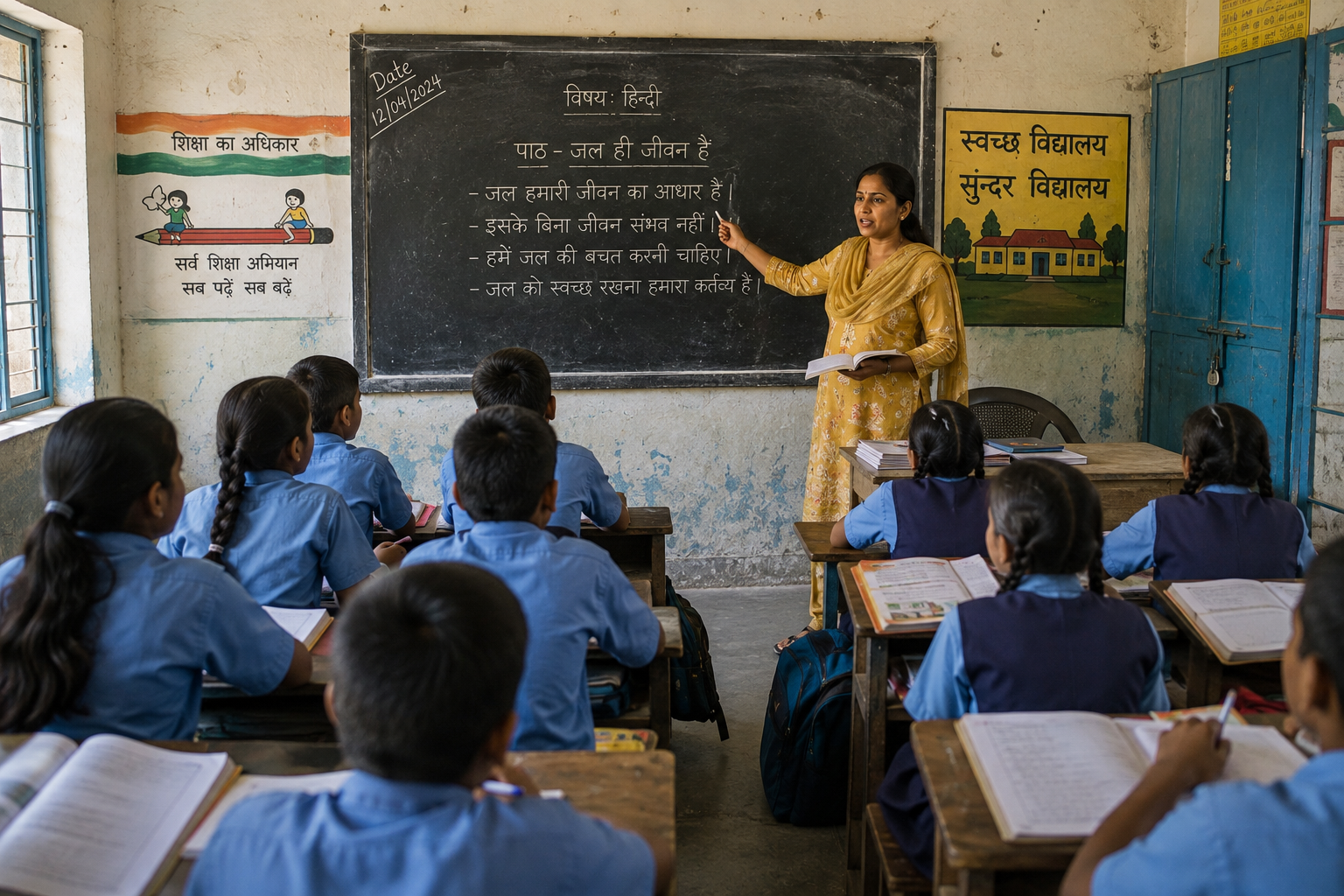
“A single teacher cannot realistically perform the work of an entire school staff. The teacher has to manage multi-grade teaching, different subjects, administrative work, student records and interaction with parents. This directly affects the quality of classroom teaching, particularly in remote and rural areas,” school education experts said.
Educationists argue that the problem has survived successive governments because policy discussions often remain disconnected from ground realities.
“We regularly hear about national and international conferences, workshops and policy dialogues on strengthening school education. Important resolutions are passed and reports are prepared.
“But the real test of education reform is whether a child sitting in a remote government school has enough teachers, classrooms, toilets, electricity, drinking water and learning resources. Unless these basic issues are addressed, many decisions will remain confined to papers and conference halls,” experts observed.
The concern becomes more significant in Jammu and Kashmir, where geography creates additional challenges. Schools in hilly, border and remote areas often require greater attention because teacher availability, transportation and infrastructure constraints can be far more severe than in urban centres.
The Ministry of Education has maintained that recruitment, service conditions and deployment of teachers fall within the administrative domain of the respective States and Union Territories. Teacher vacancies arise due to retirement, resignation, creation of new posts, rationalisation of deployment and changes in student enrolment.
The Centre periodically advises States and Union Territories to fill vacant teaching posts through transparent and merit-based recruitment processes and provides financial assistance under Samagra Shiksha to help maintain appropriate pupil-teacher ratios.
The National Education Policy (NEP) 2020 emphasises maintaining a pupil-teacher ratio of below 30:1 in each school and below 25:1 in areas with a high proportion of socio-economically disadvantaged students.
However, experts point out that an overall pupil-teacher ratio does not always reflect the reality inside individual schools.
“A satisfactory average ratio can hide serious inequalities. One school may have more teachers than required, while another may be functioning with just one teacher. Therefore, the focus should shift from only State-level averages to school-wise and region-wise teacher availability,” education experts said.
The issue is not confined to Jammu and Kashmir. At the national level, India had 1,00,843 single-teacher schools across all management categories in 2025-26.
The number of teachers in position from pre-primary to secondary level across the country increased to 95,74,324 in 2025-26, compared with 94,38,291 in 2024-25 and 91,55,644 in 2023-24. India had 14,66,682 schools in 2025-26.
The national data shows progress in the overall teacher workforce, but the existence of more than one lakh single-teacher schools indicates that the challenge of equitable teacher distribution continues across the country.
For Jammu and Kashmir, the question is whether the transition from State to Union Territory has translated into visible improvement at the grassroots level of school education.
Experts believe future reforms must focus on timely recruitment, rational and transparent deployment, special incentives for teachers serving in remote and difficult areas, reduction of non-teaching workload and regular school-level monitoring of infrastructure requirements.
“School education cannot be strengthened through announcements alone. Every policy must finally reach the classroom. A school without adequate teachers or basic infrastructure cannot deliver the quality education envisioned in NEP 2020, regardless of how strong the policy framework appears on paper,” they maintained.
As governments continue to discuss the transformation of school education, the latest UDISE+ data serves as a reminder that for thousands of students and teachers, the struggle remains rooted in basic necessities.