News Beyond Headlines
News Beyond Headlines
In Conversation with
Blazing Tales launches “In Conversation with”, an exclusive interview series featuring eminent personalities who are making significant contributions in their respective fields and shaping society through leadership, innovation and public service. As one of the newspaper’s unique editorial features and a key USP, the series aims to bring readers closer to policymakers, administrators, academicians, scientists, entrepreneurs, sportspersons and other distinguished personalities through insightful and candid conversations.
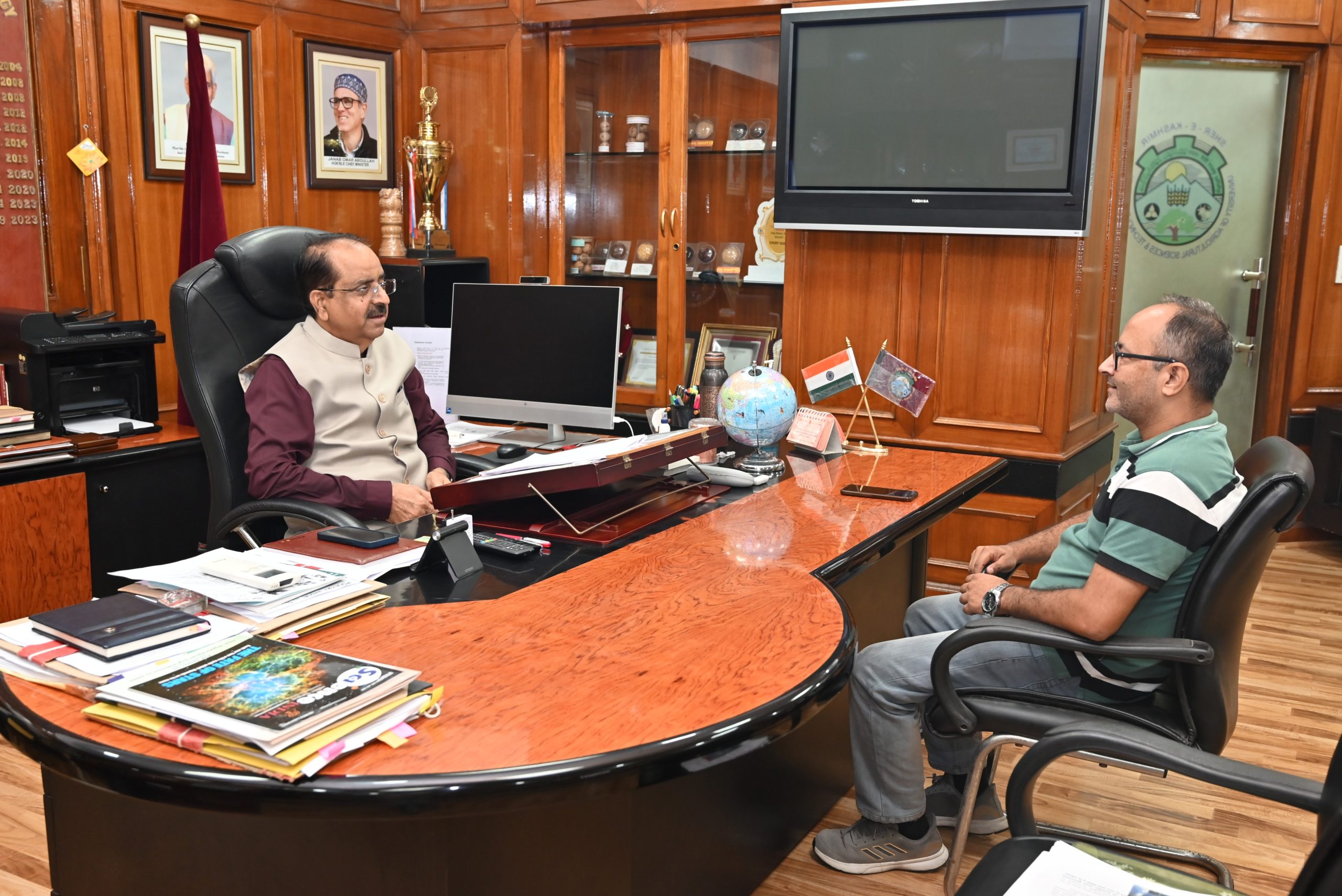
In its inaugural edition, Blazing Tales Editor and Senior Journalist Vikas Sharma speaks with Prof. (Dr.) B. N. Tripathi, Vice-Chancellor of Sher-e-Kashmir University of Agricultural Sciences and Technology of Jammu (SKUAST-Jammu), on the university’s vision, achievements, research, innovation, farmer-centric initiatives, challenges and the future of agricultural education in Jammu and Kashmir.
VIKAS SHARMA
JAMMU, JULY 31: Enhancing the quality of education, strengthening research infrastructure, promoting innovation and extension activities, and implementing other key academic initiatives are among the top priorities of Sher-e-Kashmir University of Agricultural Sciences and Technology of Jammu (SKUAST-Jammu), Vice Chancellor Prof. (Dr.) B. N. Tripathi has said.
In an exclusive interview with Vikas Sharma, Senior Journalist and Editor of Blazing Tales English Monthly Newspaper, Prof. (Dr.) Tripathi expressed confidence that SKUAST-Jammu is on course to emerge as a globally recognised Institution of Excellence in agricultural education, research, innovation, and extension.
Prof. (Dr.) Tripathi, who served as Deputy Director General (Animal Science), Indian Council of Agricultural Research (ICAR), New Delhi, from January 30, 2020, to June 19, 2023, before assuming charge as the Vice Chancellor of SKUAST-Jammu, spoke extensively about the university’s academic programmes, research initiatives, achievements, future roadmap, and the challenges facing the agricultural education sector.
Prof. (Dr.) B. N. Tripathi is a distinguished veterinary scientist, academician and administrator with over three decades of experience in agricultural education, research and institutional leadership.
Born on July 20, 1962, in Uttar Pradesh, Prof. Tripathi graduated in Veterinary Science from the College of Veterinary Science, Mathura, and earned his M.V.Sc. and Ph.D. from the Indian Veterinary Research Institute (IVRI), Izatnagar.
Before assuming charge as Vice Chancellor, he served as Deputy Director General (Animal Science), Indian Council of Agricultural Research (ICAR), New Delhi, from January 2020 to June 2023, besides holding several key leadership positions in premier national research institutions. Internationally recognised for his contributions to animal health, veterinary sciences and agricultural research, he has authored over 200 research papers, developed several diagnostic and vaccine technologies, secured multiple patents, and received numerous national and international honours. He is also a Fellow of several prestigious scientific academies and has represented India at leading global forums, including FAO, WHO, SAARC and BIMSTEC meetings.
“My vision is to transform SKUAST-Jammu into a National level Centre of Excellence by 2030”, Prof Tripathi told Blazing Tales Editor.
“The way we are working all day and night for fulfillment of vision and objectives I am pretty hopeful that by 2035 we shall definitely gained global recognition as well. Infact, we are empowering youth through entrepreneurship, enhancing famer-centric technologies, fostering international collaborations thereby making SKUAST-Jammu a catalyst for rural prosperity and sustainable development in Jammu and Kashmir”, veteral agricultural scientist said.
He futher stated that one of the majo contributions is to provide quality and competent human resources to the state and nation.
“Our other major contributions has been ensuring the timely availability of quality seeds. The University develops breeder seed, which is subsequently multiplied into foundation and certified seed through our research stations, government departments and seed agencies before reaching farmers”, Prof Tripathi added.
Vice-Chancellor further said the varsity is focussing on industry-academic collaborations to promote agripeneurship.
“SKUAST-Jammu has also emerged as a catalyst for agripreneurship and rural development. Through incubation, skill development and startup promotion programmes, the varsity has supported more than 300 agripreneurs across different districts of Jammu and Kashmir besides creating employment opportunities for educated rural youth”, SKUAST-Jammu Vice Chancellor said.
“Today, a substantial portion of quality seed sown in the Jammu region originates from technologies developed by SKUAST-Jammu. One quintal of breeder seed generates about 6400 quintals of cerified seed in rice and 3600 quintals in wheat”, Prof Tripathi stated.
“In traditional Basmati cultivation, nearly 80 percent of the seed used by farmers is sourced from SKUAST-Jammu developed seed chains. Further, more than 75 percent of the wheat and paddy seed requiement of the region is met through seed produced from University developed breeder seed. Since its inception in 1999, SKUAST-Jammu has contributed to substantial gains in crop productivity in the Jammu region”, he added.
“SKUAST-Jammu has developed 50 improved crop varities, with additional varities in the advanced stages of release, addressing the needs of productivity enhancement, climate resilience, quality improvement and market competititveness. The University has also successfully modernised the world famous traditional Basmati-370 by developing improved varities such as Basmati-118, 123 and 138, which retain the superior grain quality, aroma and cooking characterstics preferred in domestic and international markets but mature 15-20 days before”, Dr Tripathi said.
“SKUAST-Jammu has made significant strides in research and innovation. During the last two years, the university executed as many as 84 externally funded research projects worth Rs 136 crore, developed improved crop varities, filed 21 patents (with 10 granted), published 324-high quality National Academy of Agricultural Sciences (NAAS)-rated research papers and developed technologies ranging from AI-based irrigation systems to biodegradabe films, microbial consortia and rapid diagnostic kits”, SKUAST-Jammu VC said.
Prof Tripathi infomed that the university has established the Bayer Learning Centre under a Public-Private Partnership model to meet the highest standard of research followed by multinational agri companies. Other achivements for SKUAST-Jammu include Sustainable Aquaculture Innovation Centre, Basmati Rice Research Centre, Artificial Intelligence Laboratory, Remote Sensing and GIS Laboratory, Gene Bank, Cold Storage Facilities, Quality Control and Pesticide Residue Laboratory, Centre for Innovation and Entrepeneurship Development, Walnut Processing and Packaging Centre at Doda and Pasteurization Plant at Mushroom Centre besides other many achievements.
“It is only that there are achievements, but at the same time there are many challenges also confronting us. We are addressing these through climate-resilient crop varities, precision agriculture, digital advisory services, value addition, mechanization and continuous capacity building through our Krishi Vigyan Kendras (KVKs) and extension programmes”, Dr B N Tripathi said.
“We are very much aware that farmers in Jammu and Kashmi are confronted with multiple challenges like increasing climate variability, shrinking landholdings, rising input costs, labour shortages, declining natural resources and volatile market prices. Another major concern is that less than 2 percent of agricultural produce in the region undergoes value addition, resulting in significant post-harvest losses and lower returns to farmers. We are on the job already to address all these valid concerns of farmer community in Jammu and Kashmir”, Dr Tripathi maintained.
“We are not just focussing on enhancing agricultural education but at the same time taking many other initiatives beyond that. One such initiative is launching on National cadet corps (NCC) in the campus. NCC plays an important role in leading a disciplined life and for our young promising scientiests (men and women) NCC will be a blessing”, said the SKUAST-Jammu Vice Chancellor.
Calling agriculture the backbone of India’s economy, Prof. (Dr.) B. N. Tripathi said the future of the sector depends on scientific innovation, sustainable farming practices and the active participation of young professionals.
“SKUAST-Jammu is committed to transforming agriculture through quality education, cutting-edge research, technology-driven extension services and strong partnerships with farmers, industry and national as well as international institutions. Our ultimate objective is to improve farmers’ livelihoods, strengthen food and nutritional security, promote entrepreneurship and contribute meaningfully to the sustainable development of Jammu and Kashmir as well as the nation,” he said.
Expressing confidence in the university’s future, Prof. Tripathi said that with the collective efforts of scientists, faculty members, students, policymakers and the farming community, SKUAST-Jammu is well positioned to emerge as one of India’s leading agricultural universities and a globally recognised centre of excellence in agricultural education, research, innovation and extension in the years ahead.

Very nice